
I recently rewatched Michael Mann’s 2009 crime epic Public Enemies while laid up with a bad head cold.
The film may seem an odd choice for sick day viewing; it is a heavy and portentous affair, Mann’s characters laboring, as always, under the Sisyphean weight of manly obligations.
Not exactly a pick-me-up.

And yet, a good, muscular film–but not a great one. And on this rewatch–my first since seeing it in the theater 15 years ago–it also struck me as a peculiarly annoying film, in certain hard-to-place ways…the most obvious of them being…
Didn’t Michael Mann already do this, and do it better, in Heat?
Reductive, simplistic–annoying–I know, I know, but it’s hard to slog through all two-plus hours of Public Enemies without repeatedly being put in mind of Heat’s many accomplishments and this film’s inability to realize them anew.
Like Heat, Public Enemies (at least as the marketing would have it) divides its story between an ace robber and the obsessive lawman on his tail. As in Heat, Mann seems to divide his sympathies evenly between cops and crooks, and like Heat, Public Enemies takes great interest in the minutiae of how these tough guys walk and talk, the doctrines to which they are bound and the processes they must master, the emotional and psychological weight of their grave business.
Unfortunately, Public Enemies’ screenplay does not do its story the same favors that Heat’s does for its own rich and robust story. When concerned with kinetic action, Public Enemies succeeds, but it too often drifts outward in disparate directions, interestingly touching at the founding of the FBI and J. Edgar Hoover’s role as a burgeoning power player, but lingering interminably and implausibly on the romance between the antagonist gangster and his would-be moll (Johnny Depp and Marion Cotillard).
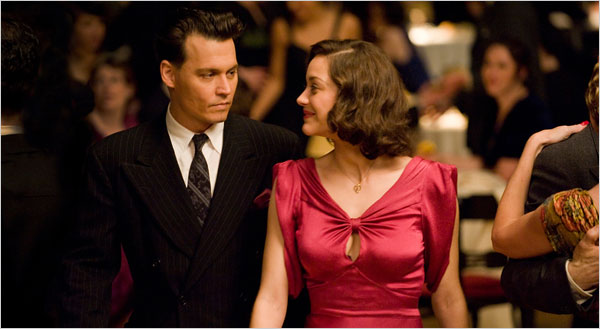
Equitable relationship dynamics, the female soul, female agency–these are not things at which Michael Mann excels.
Also, above I called Depp’s character, infamous depression-era bank robber John Dillinger, the film’s antagonist. I also said Mann divides his sympathies evenly. These seem to be the film’s intentions, but in practice, Dillinger/Depp reads as the protagonist and far, far more time is given to him, his relationships and whatever bits of psychological and emotional motivation the film can scrape together to offer his character. I may be getting prudish in my old age, but this imbalance makes the film less successful and perhaps more…annoying?
For one, and this should come as no surprise, Dillinger and his crew are very bad men. They swoop into cavernous banks like avenging angels in black hats and topcoats, casually pummeling security guards and bank managers before making off with the loot. And yet, there is no sense that they are avenging anything. Dillinger’s status as a Robin Hood-like folk hero who stole from the wealthy and hated banks of the depressed and blighted Midwest is given no play here. These guys just seem like psychopaths and not particularly likeable ones at that.
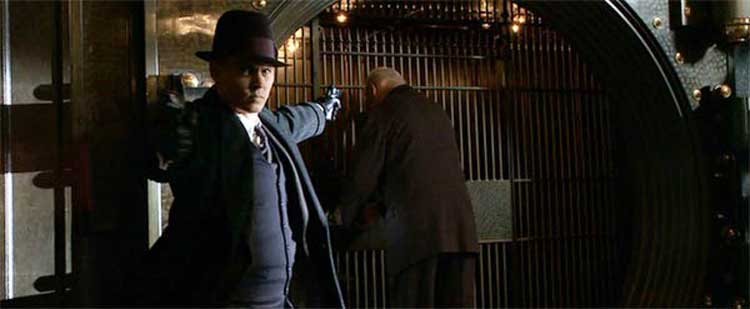
Heat’s novelistic approach allowed us to sympathize with Neil Macauley and crew, but there was no mistaking who they were. The story, we knew, would move inexorably toward their downfall. Dillinger is rather likeable here, make no mistake about it. Depp turns in a real movie star performance and yet one that, the longer I sit with it is…kind of…annoying?
In a nutshell, Depp is too pretty to play a guy this tough and bad. But then again, that’s movies and that’s actors. He actually pulls it off, evincing a dark, suave menace. The kind of guy we hope to teach our kids to avoid–evil in an alluring package. But the script just doesn’t give him enough to work with. Beautiful leading men of the Depp-Pitt variety are at a disadvantage when playing a true heavy. The character needs some sideways element–a rakish sense humor or a hint of genuine loserdom (see Paul Newman or George Clooney)–or you risk what we end up with here: John Dillinger by way of Liam Gallagher. A pretty, insufferable jerk whose inner life we don’t know and eventually don’t care to know.

Unfortunately, Mann doesn’t really do happy-go-lucky. Humor doesn’t really exist in the Mannoverse. Neither does small talk, banalities. Like the players in a Greek tragedy, his characters have a 1:1 relationship with what must be done. To deviate from the pull of fate is to invoke your own demise.
So how do we still end up with…

…and…

…???
Serendipity, I suppose. The fortuitous marriage of a good script and a great actor.
As Vincent Hanna, Al Pacino not only provides the perfect contrast to Robert DeNiro’s ultra-taciturn Neal McCauley, he creates one of the only truly colorful and offbeat characters in Mann’s entire oeuvre–an oeuvre, I think it is fair to say, that is pretty great but also takes itself extremely seriously. That Mann’s work is able to be so grandiose and yet, in most instances, so enjoyable to consume constitutes a rare achievement.
I don’t know, maybe I’m just a comedy guy at heart. Or a shallow aesthete. A lightweight. It’s just that I find people who take themselves too seriously a bit….
Annoying.
Addendum: You may have noticed that up to this point, this blog has almost exclusively been about discussing and celebrating pop culture that means something to me. Simply put, I find the idea of taking one’s precious (unpaid) time and energy to write negative things about the work of professional artists to be highly, highly–you guessed it–annoying.
You may have also noticed that I have not posted in some time. A lot of busy life stuff is to blame, almost all of it positive, but time-consuming nonetheless. I watched Public Enemies, had some thoughts about it, and in the name of getting something written, dashed this off. So in the spirit of generosity and collaboration, I’d like to neutralize some of my negativity by throwing it out to you–what do you think about Public Enemies, Heat, Michael Mann, life in general? Post your thoughts in the comments.
I will not be annoyed, I promise.


I know what it feels like for a film to be annoying (even if I don’t hate it). TV shows too (but mostly because of characters doing stupid things they have to do in order to achieve some kind of redemption or downfall as the seasons progress).
I like what you said in the paragraph that begins with, “For one, and this should come as no surprise, Dillinger and his crew are very bad men.”
I love Heat so much. I don’t remember if I saw Public Enemies at the theatre, but I must have because it ticks off a lot of boxes for films that interested be back then (the cast, the director, the premise). I may have to look up some YT clips in the near future to jog my memory.
Is your head cold better?
LikeLiked by 1 person
All better, thanks! And I rewatched like 3/4 of Heat for good measure!
LikeLike